
A diabolically zealous enterprise
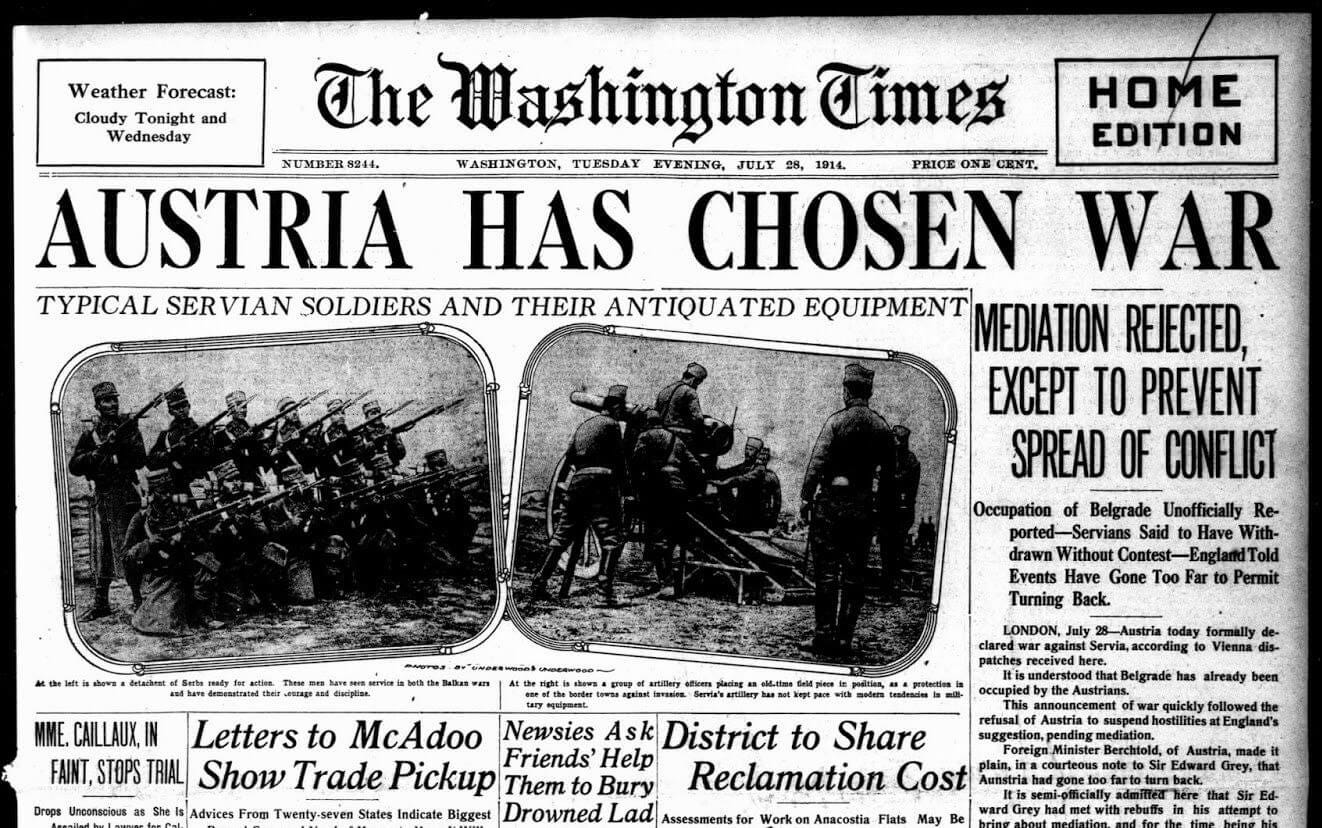
Austria's ultimatum to Serbia was 'written to be rejected'; it was a declaration of war

What have we done? And why? Join me ‘On Earth As It Is’ . . . because only by understanding the past will we free ourselves from its tyranny.
They were acutely aware of the likelihood of a wider war in an extremely tense situation: one doesn’t calm a wasp’s nest by shaking the tree.
Next Thursday: Serbia replies
IF WE STRIP AWAY the diplomatic noise and examine the true provenance of Vienna’s ultimatum to Serbia delivered on 23 July 1914, the last disgusting acts of the men who brought war to Europe become clearer.
Throughout that month, Berlin posed as an innocent peace-maker alongside Vienna, the stark aggressor.
In fact, Berlin was intimately involved in encouraging Austrian bellicosity every step of the way, and spun a web of lies to cover its aggression.
The story is intricate, yet vital to our understanding of what caused the coming conflagration. This was a casus belli manufactured by men desperate for war.
A circular sent by Berlin on 21 July to its embassies in London, Paris and St Petersburg gave the appearance that Germany had no knowledge of the Austrian ultimatum to Serbia (sent ostensibly to avenge the murder of Franz Ferdinand on 28 June).
The circular stated, with contrived innocence, that Austria-Hungary’s demands on Serbia ‘can only be regarded as fair and moderate’.
Germany’s ambassadors were therefore instructed ‘to give emphatic expression’ to the view that the conflict between Austria-Hungary and Serbia would be limited ‘to those directly concerned. We anxiously desire the localization of the conflict because any intervention by another Power might . . . bring incalculable consequences in its train.’
Berlin’s ambassadors knew that an Austrian attack on Serbia would bring Russia and probably France into the war. Yet they were expected to portray what would become a Europe-wide conflict as a limited and ‘moderate’ action. They were to pat the head of a gorgon.
The German Chancellor Theobald von Bethmann-Hollweg and other senior German officials (if not Germany’s ambassadors) knew the precise wording of the ultimatum, but they wished to give the impression they knew nothing, so they could later claim they were innocent of Austria’s extremely harsh terms – in other words, so they were free to provoke a war and then abjure responsibility for causing it.
The truth is, of course, that the German Government knew everything in Vienna’s box of tricks. Berlin had been pulling the strings throughout: ‘[A]ll the acts and all the roles in the tragedy were settled in advance in Berlin,’ concludes the great Italian historian Luigi Albertini.
—
The evidence of German complicity was a telegram sent on 18 July by Hans Schoen, the Bavarian League counsellor in Berlin, to the league’s Munich office.
Arthur Zimmermann, the German undersecretary of state, had told Schoen the contents of Vienna’s ultimatum to Serbia.
It would demand, for example, that the King of Serbia be compelled publicly to dissociate his government from the pan-Serb movement, and that an Austrian official be permitted to participate in the judicial proceedings against the ‘accomplices’ in the Sarajevo murder.
Such demands, Zimmermann knew, were ‘incompatible with Serbia’s dignity’. Self-evidently Belgrade would not comply: ‘The consequence therefore is no doubt war,’ he noted.
Zimmermann enlarged upon Germany’s true role, in what he admitted could become a European war. Berlin, Schoen quoted him as saying, ‘absolutely agreed that Austria is to use the favourable moment [to declare war] even at the risk of further complications [i.e. a European war] . . .’
If this happened, Zimmermann said, Germany would take ‘diplomatic steps’ to give the impression of being innocent of Austria’s actions.
One diplomatic step was that the entire German Government would go on holiday when the ultimatum was delivered. Their aim was to ‘localise’ the war, by pointing out that the Kaiser, chief of the General Staff and the Prussian war minister were absent on leave, ‘proof of the fact that Germany has been no less taken by surprise by the Austrian action than the other powers . . .’
That is, Germany’s protestations of innocence at the contents of the note to Serbia were, as the mad Kaiser might have put it, ‘Bunkum’.
These men were diabolically zealous for a war on Serbia. Such is the banality of state violence: slouching towards Armageddon at a pen stroke.
—
The Entente powers (Britain, France and Russia) were aware of the contents of the Austrian ultimatum a few days before its delivery.
Russia’s reaction was the most violent and portentous: ‘A whole country could not be held responsible for the acts of individuals,’ Sergey Sazonov, the Russian foreign minister, yelled at Count Heinrich von Pourtalès, German ambassador at St Petersburg, when he heard the news. Vienna wanted ‘the annihilation of Serbia’, Sazonov exclaimed. ‘And the best thing, too,’ the Kaiser noted dementedly on the transcript of this discussion.
—
Paris first heard of the Austrian note on 20 July when a French spy in Vienna sent an assessment of Austria’s demands and the likely repercussions to the French consuls.
This Consular Report reached Paris a day before Prime Minister Raymond Poincaré met the Tsar, on 21 July, in St Petersburg. It warned: ‘. . . much will be demanded of Servia [Serbia] . . . The tenor of the note and its imperious tone almost certainly ensure that Belgrade will refuse. Then military operations will begin. There is here, and equally at Berlin, a party which accepts the idea of a conflict of widespread dimensions, in other words, a conflagration.’ That is, both Germany and Austria now contemplated the risk of a European war.
Poincaré had reached the same conclusion. He arrived at St Petersburg on 20 July and received a fittingly lavish reception aboard the Tsar’s yacht, the Alexandria. The two allies sat at the stern and talked long and deep. The French leader soon dominated the slightly addled Tsar Nicholas.
The next day, their talks focused on the Austro-Serbian dispute. France and Russia would do everything to support Serbia, a relationship Poincaré brazenly underlined at a diplomatic reception that afternoon. Poincaré even warned the sheepish Austrian ambassador to Russia, Count Frigyes Szapáry, to be twice as vigilant in the present climate:
‘With a little goodwill, Poincaré told the Austrian diplomat, ‘this Serbian business is easy to settle. But it can just as easily become acute. Serbia has some very warm friends in the Russian people. And Russia has an ally in France. There are plenty of complications to be feared!’
This hardly appeased Szapáry, who interpreted it as a Franco-Russian threat, not a plea for calm.
Later, Poincaré, alone with the Tsar and Maurice Paléologue, the new French ambassador to St Petersburg, laid bare his concerns about this chat with the Austrian ambassador: ‘The Ambassador had obviously been instructed to say nothing.’ He concluded that ‘Austria has a coup de théâtre in store for us’.
—
When Berlin received an official copy of the ultimatum, a day early, on 22 July, the senior ministers acted in character. They publicly affected great surprise at its harshness.
Bethmann-Hollweg, Zimmermann and other German ministers feigned surprise at the ‘tough’ terms. The note was ‘in every respect too sharp’, they pretended.
It is easy to prove their incredulity was feigned. If they thought the ultimatum so harsh, and likely to lead to war, why did none of them seek to ease its terms, or send their concerns to Vienna, or amend the note before it reached Serbia? Why did they not issue fresh instructions to their ambassadors, who had been told to regard the note as ‘fair and moderate’?
The German Government had had ample time to ask Vienna to moderate the terms but did nothing. Their inaction chimed with Berlin’s general deceit, which sought to persuade the world that it had neither knowledge of nor involvement in Austria’s determination to wage war on Serbia.
—
And so the world slouched towards a general catastrophe. The Austro-Hungarian Government, goaded by Germany, continued quietly mobilising its forces.
A war council met in Vienna on 19 July and decided unanimously that Austro-Hungarian forces should strike soon, as Serbian forces, they claimed, were amassing along the border. Once victorious, the imperial army would depose the Serbian royal line and redraw the frontiers.
On 22 July, eight Austro-Hungarian army corps – more than 300,000 men – approached the Serbian border. Vienna intended to attack Serbia with ‘the greatest severity’, the French ambassador cabled Paris that day.
At the same time, the official Austro-Hungarian news agency reprinted the most inflammatory passages from the Serbian press to arouse public feeling for war. Through these precipitate actions, Berlin and Vienna needlessly antagonised France and Russia.
They were acutely aware of the likelihood of a wider war in an extremely tense situation: one doesn’t calm a wasp’s nest by shaking the tree. Yet that is exactly what they did. They all talked of a ‘local’, Balkan war but knew the likely, terrible repercussions.
And, when the world discovered that Berlin ‘held all the threads’, noted Albertini, ‘such an avalanche of general indignation and mistrust’ would descend on the German rulers that they would be ‘totally discredited and all attempts to save the peace . . . in vain’.
—
The ‘war ultimatum’ was delivered on 23 July 1914 to the Serbian Prime Minister Nikola Pašić by the Austrio-Hungarian diplomat, Wladimir Rudolf Karl Freiherr Giesl von Gieslingen. Let’s call him Giesl.
Giesl arrived at the Serb Foreign Ministry in Belgrade an hour late, at 6 pm. Pašić was absent, so one Dr Paču, acting prime minister, received him.
Paču told Giesl that he could not accept the Austrian message; only the prime minister had the responsibility to do so. Giesl dismissed this excuse. He would wait. In the age of railways and telegraph, the premier’s return ‘could be only a matter of a few hours’.
Pašić failed to show up and Paču continued refusing to accept the ultimatum, so Giesl left the sealed envelope on the table and told him to do as he wished with it. If the Serbian officials, Giesl declared, refused to send an unconditional acceptance of Vienna’s demands within the 48-hour deadline, he was commissioned to pack up the Austro-Hungarian Embassy and leave Belgrade together with his staff and passports. He turned and left.
—
On Giesl’s departure, Paču and his colleagues tore open the letter and scoured its contents. Austria-Hungary’s principal demands were as follows:
The Austro-Hungarian Ultimatum to Serbia Vienna 22nd July 1914 . . . It is clear from the statements and confessions of the criminal authors of the assassination on the 28th June that the murder . . . was conceived at Belgrade . . . The Royal Serbian Government will [as a result] pledge itself:
1. To suppress every publication which shall incite to hatred and contempt of the (Austro-Hungarian) Monarchy . . .
2. To proceed at once to the dissolution of the Narodna Odbrana [the pan-Serbian movement], to confiscate all of its means of propaganda, and in the same manner to proceed against the other unions and associations in Serbia which occupy themselves with propaganda against Austria-Hungary . . .
4. To remove from the military and administrative service in general all officers and officials who have been guilty of carrying on the propaganda against Austria-Hungary . . .
5. To agree to the cooperation in Serbia of the organs of the Imperial and Royal Government in the suppression of the subversive movement directed against the integrity of the Monarchy . . .
6. To institute a judicial inquiry against every participant in the conspiracy of the twenty-eighth of June [the assassination of Franz Ferdinand] who may be found in Serbian territory; the organs of the [Austro-Hungarian] Government delegated for this purpose will take part in the proceedings . . .
The ultimatum maximised Serbia’s humiliation and trod all over its sovereignty. Of its time, Austria’s demand was utterly unacceptable and amounted to a declaration of war. Vienna expected Serbia’s reply no later than Saturday 25th July at 6 pm.
Next Thursday, 16 July 2026: Serbia replies
Selected sources and further reading:
Albertini, Luigi, The Origins of the War of 1914 (3 vols), Enigma Press, New York 2005
Bethmann Hollweg, Theobald von, Reflections on the World War, (transl. by Young, George), Cornell University Library, New York, 1920
French Yellow Book, Chapter II, No. 8. M. Dumaine, French Ambassador at Vienna, to M. René Viviani, President of the Council, minister for foreign affairs, Vienna, 2 July 1914.
Geiss, Imanuel, July 1914 The Outbreak of the First World War: Selected Documents, Charles Scribner’s Sons, New York 1967
Hochschild, Adam, To End All Wars: A Story of Loyalty and Rebellion, 1914–1918, Mariner Books, Boston 2012
Hötzendorf, Conrad von, Aus meiner dienstzeit, 1906–1918, University of Michigan Library, Ann Arbor 1921
Keiger, John, Raymond Poincaré, Cambridge University Press, Cambridge 1997
Ludwig, Emil, July 1914, Putnam, London 1929
Ludwig, Emil, Wilhelm Hohenzollern: The Last of the Kaisers, AMS Press Inc, New York 1978
Margutti, Albert von, La Tragédie des Habsbourg, Bibl. Rhombus, Vienna 1923
Paléologue, Maurice, An Ambassador’s Memoirs, (transl. by Holt, Frederic), George H. Doran Company, New York 2008
Seton-Watson, Robert, Sarajevo: A Study in the Origins of the Great War, Hutchinson, London 1925
Smith, David James, One Morning in Sarajevo: 28 June 1914, Phoenix Press, London 2009
Sondhaus, Lawrence, Franz Conrad von Hötzendorf: Architect of the Apocalypse, Brill Academic Publishers, Leiden, Netherlands 2000
Sosnosky, Theodor von, Franz Ferdinand. Der Erzherzog-Thronfolger. Ein Lebensbild, Verlag Von R. Oldenbourg, Munich 1929
Strachan, Hew, The First World War: Volume I: To Arms, Oxford University Press, USA 2003
Sulzberger, Cyrus Leo, The Fall of Eagles, Crown Publishers, New York 1977
The World War I Document Archive, ‘The Assassination of Archduke Franz Ferdinand’: http://wwi.lib.byu.edu/index.php/The_Assassination_of_Archduke_Franz_Ferdinand
The World War I Document Archive, Records of national diplomatic communication: The Belgian Grey Book, The French Yellow Book, The German White Book, The Russian Orange Book, The Serbian Blue Book, The Austro-Hungarian Red Book, see also: http://www.gwpda.org/
This essay is an edited extract from my book 1914: The Year the World Ended published by Penguin Random House (UK and Australia).