
A glimpse inside Hegel's head
Did human history begin and end in the mind of this philosopher? Let's take a look...

This is Who made our minds?, my Thursday essay probing the greatest, cruellest and most beautiful minds of the past 5,000 years, inspired by my book, The Soul: A History of the Human Mind and many more. Join our exploration of the human mind.
Next Thursday: The spectre of Karl Marx
A PIVOTAL MOMENT in the life of the German philosopher Georg Wilhelm Friedrich Hegel (1770–1831) was hearing the news of Napoleon’s victory over Prussia in the Battle of Jena–Auerstedt on 14 October 1806.
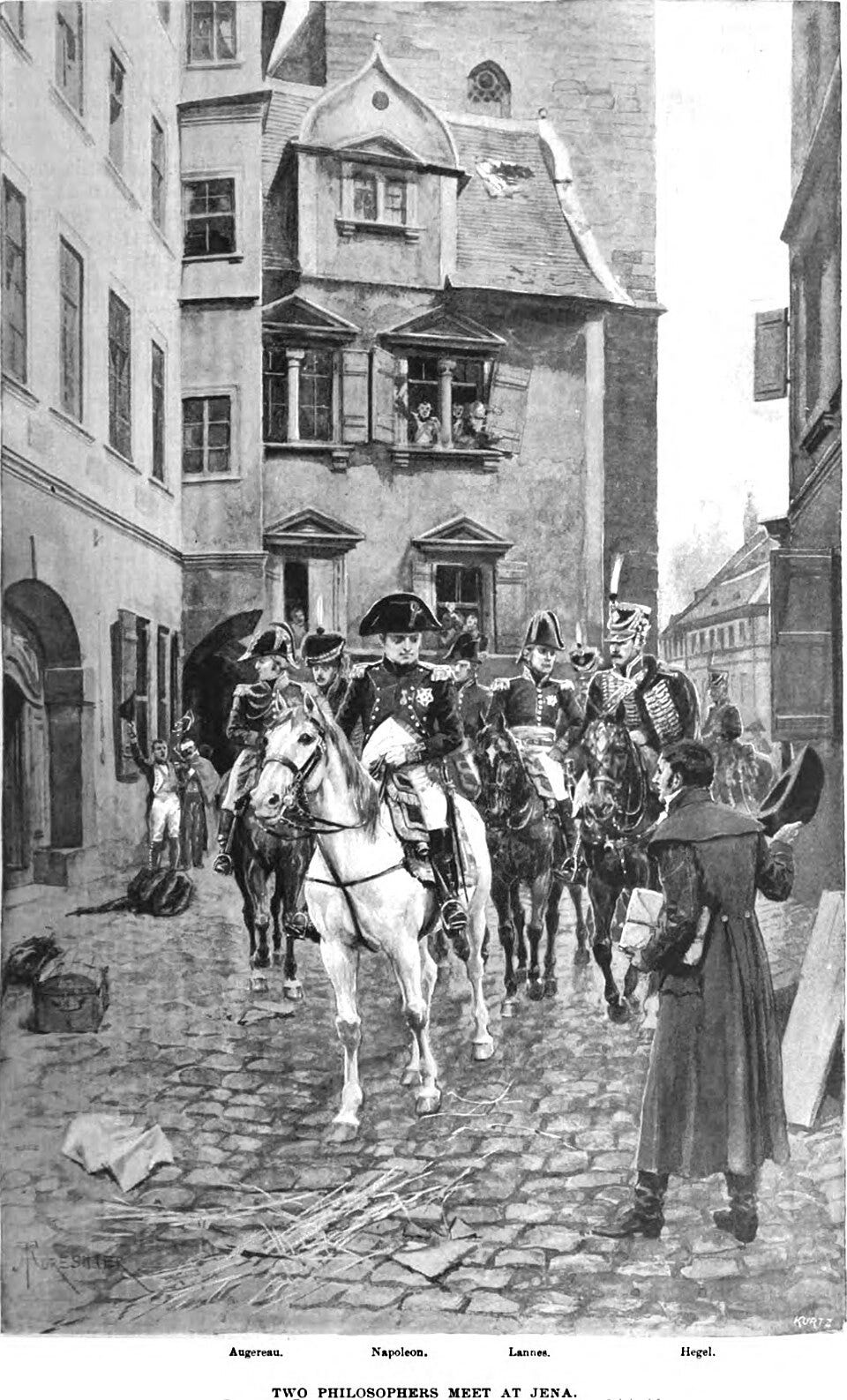
Hegel, living in Jena at the time, paused from his work to write a letter in praise of his nominal enemy, the French emperor:
‘[T]his world soul . . . I saw riding through the city to review his troops; it is indeed a wonderful feeling to see such an individual who, here concentrated into a single point, sitting on a horse, reaches out over the world and dominates it.’
After Napoleon’s defeat at Waterloo, Hegel mourned ‘the spectacle of an immense genius destroyed by mediocrity’.
He thought of Napoleon as the embodiment of the ‘national spirit’, the epitome of the supreme, self-liberated mind that unified thought and action as the fulcrum of his age.
Napoleon was his own emperor and his own pope, Hegel declared, a ‘Great-Souled’ man, in whom there was ‘no darkness, whose soul is utter clearness, and complete harmony’.
Napoleon’s mind, it seemed, had entered the last stage of Hegel’s conception of history: ‘The history of the world is none other than the progress of the consciousness of freedom’, where ‘the highest attainment is self-knowledge’.
—
History was thus the development of ‘the Spirit in Time’, just as nature was the development of ‘the Idea in Space’. Such were the themes of Hegel’s entire opus.
Human history, in Hegel’s conception, is the gradual liberation of the mind from the primitive state of nature towards the most refined expression of self-consciousness, or what Hegel called ‘absolute knowledge’.
All thought, will, belief, faith and hope ended in absolute knowledge, the most advanced stage of the liberation of consciousness.
Brace yourself. We shall limit our brief flight around Hegel’s head to his idea of history as the liberation of the ‘mind’ or ‘consciousness’ (the preferred translation of Geist, according to the philosopher Peter Singer, whose superb introduction to Hegel will help guide us).
Was it even possible to describe the liberation of the human mind? Hegel’s approach was to immerse himself in the ‘phenomenology of mind’ – that is, to examine how the mind appears to itself.
What he meant was that humankind could only understand consciousness by observing how it appeared to the conscious person. Hence, ‘phenomenology’ – from the Greek meaning ‘to appear’ – was the study of how consciousness appeared to itself.
Hegel’s purpose was to separate our objective understanding of the mind from the mind’s understanding of itself.
How? Can a ‘thinking thing’ like you or me think about how we appear to think?
—
Hegel explained his method as the ‘exposition of knowledge as a phenomenon’.
Here comes Singer to our rescue: ‘Hegel’s Phenomenology of Mind [his master work] traces different forms of consciousness, viewing each one from inside, as it were, and showing how more limited forms of consciousness necessarily developed into more adequate ones.’
Those merely ‘adequate’ forms of consciousness (eg perception of the world, surviving, hunting) would lead to higher forms that freed the mind from its shackles – both social and self-imposed – culminating in genuine or absolute knowledge.
And what was absolute knowledge? It was the knowledge of ‘reality itself’, as distinct from the knowledge of ‘the appearance of reality’, the mere shadows on Plato’s cave wall, the lower forms of consciousness.
In this highest stage of consciousness, the mind had achieved the supreme state of liberty, the unity of subject and object in the ‘self’ within a universe of selves.
—
Let’s trace the extraordinary process of the liberation of consciousness.
Hegel’s starting point were primitive kinds of consciousness. At the most basic level, he observed, we were conscious of things, the ‘this’ or ‘that’ of the objective world: this rock, that flint, this fork, that chair, things we barely think about even as we use them.
This ‘primitive’ form of consciousness was insufficient for human survival. To understand and live in the world required an understanding or consciousness of complex things and their uses and effects, as well as of our involvement with them: fire, canoes, the weather, animals, engines, threats, opportunities.
These objects or ideas demanded the cooperation of other conscious selves, with whom we were able to exploit the material world. Our awareness or consciousness of our ‘self’ and the ‘selves’ of others would be critical to our survival.
‘Self-awareness’, then, in Hegel’s sense, was not a solipsistic cul-de-sac, a narcissistic self-indulgence, because the very existence of our ‘self’ depended on other ‘selves’ recognising your ‘self’ or my ‘self’.
That is, your ‘self’ only exists insofar as other ‘selves’ recognise and acknowledge you.
—
As an example, think of this in the harshest terms: incarceration, slavery and exile not only withheld the liberty of the body, but also crippled their conscious idea of their ‘selves’, and sought to erase the memory of their identity. That is because the purpose of totalitarian oppression is to obliterate the conscious self by refusing to recognise it.
In this light, the survival of the ‘conscious selves’ of Arthur Koestler, Primo Levi, Victor Serge, Aleksandr Solzhenitsyn and Vasily Grossman – all imprisoned and persecuted by totalitarian regimes – astonishes us in a new and startling way.
They preserved their identities even after every vestige of the ‘self’ had been stripped from them.
They survived with what Hegel called their ‘beautiful souls’ intact. (This is not to ignore the many other survivors of the Gulag and the Nazi death camps who also held fast to their conscious ‘selves’, but they did not record the experience.)
Hegel’s ‘beautiful soul’ is a stage in his history of consciousness. The beautiful soul, he wrote, was ‘its own knowledge of itself in its pure transparent unity’ – or pure self-consciousness.
If the beautiful soul is enslaved or incarcerated, it tends to grow ‘unhinged, disordered, and runs to madness, wastes itself in yearning, and pines away in con- sumption. Thereby it gives up, as a fact, its stubborn insistence on its own isolated self-existence, but only to bring forth the soulless, spiritless unity of abstract being.’
—
This introduces a darker phase in Hegel’s history of consciousness: that of master and slave. When two selves met, and recognised the other, their immediate reaction was fear:
‘What does this other one want from me? My death? My destruction?’ A moment’s thought answered: ‘My money? My body? My freedom?’
The stronger self, seeing that he needed the ‘other’ – to work, to serve – spared the latter’s life. The stronger became the master and the weaker became the slave.
Master and slave were thus trapped in a danse macabre of hellish co-dependence.
The master failed to see that he depended on ‘his’ slaves to produce things of value, none of which were ‘his’. The slave could not enjoy the fruits of his labour, because he lived in perpetual captivity that destroyed his sense of self.
The master–slave relationship thus produced what Hegel called the ‘unhappy consciousness’ or the ‘alienated soul’, a concept Karl Marx would later apply to the alienated worker.
—
The unhappy or alienated consciousness ‘is the bitter pain which finds expression in the cruel words, “God is dead”’, Hegel wrote: ‘the ethical world has vanished, and its type of religion has passed away in the mood of Comedy.’
This ‘unhappy consciousness’ despaired of the death of the divine: ‘The statues set up are now corpses in stone whence the animating soul has flown, while the hymns of praise are words from which all belief has gone . . . from his games and festivals man no more receives the joyful sense of his unity with the divine Being.’
The master imagined himself possessing his slave like a god, even as his slave clung to the memory of the god of his dying faith.
In both master and slave, the unhappy consciousness, the alienated soul, is divided against itself. Neither master nor slave is able to sunder this life-sapping state of bondage.
Only a powerful external force could break it: war, revolution or a political transformation.
—
‘Alienated’ in a Hegelian sense described the psychological state of the ordinary human mind, from medieval to modern times, even in those who imagined themselves ‘free’.
All the rules, systems and institutions that govern social relations are forms of enslaving or rendering others dependent: from slave economies, feudal hierarchies and collective farms to sweat-shop factories, the ‘gig’ worker and their coming ‘boss’, an artificially intelligent being.
All those sources of alienation are our own inventions, AI being the most recent manifestation of self-enslavement (as Hegel would have said had he been alive to witness it).
In despair at our self-alienated state, Hegel explains, we invented an ideal being, a god, who possessed the qualities we most desired but could not find in ourselves. We imagined our god as perfect, omniscient and omnipotent, and we prayed to that god even as we thought of ourselves as ‘base, ignorant, and powerless’.
—
The tragedy of the ‘unhappy consciousness’ of master and slave is its inability to recognise its true condition, of being trapped in a ‘godless’ embrace.
As Hegel wrote:
‘What the unhappy consciousness does not realize is that the spiritual qualities of God which it worships are in fact qualities of its own self. It is in this sense that the unhappy consciousness is an alienated soul: it has projected its own essential nature into a place for ever out of its reach, and one which makes the real world in which it lives seem, by contrast, miserable and insignificant.’
‘The unhappy soul who does this,’ explained the philosopher Bryan Magee, ‘fails to realize that it is, at least in part, human characteristics that he is projecting on to a being other than himself.’
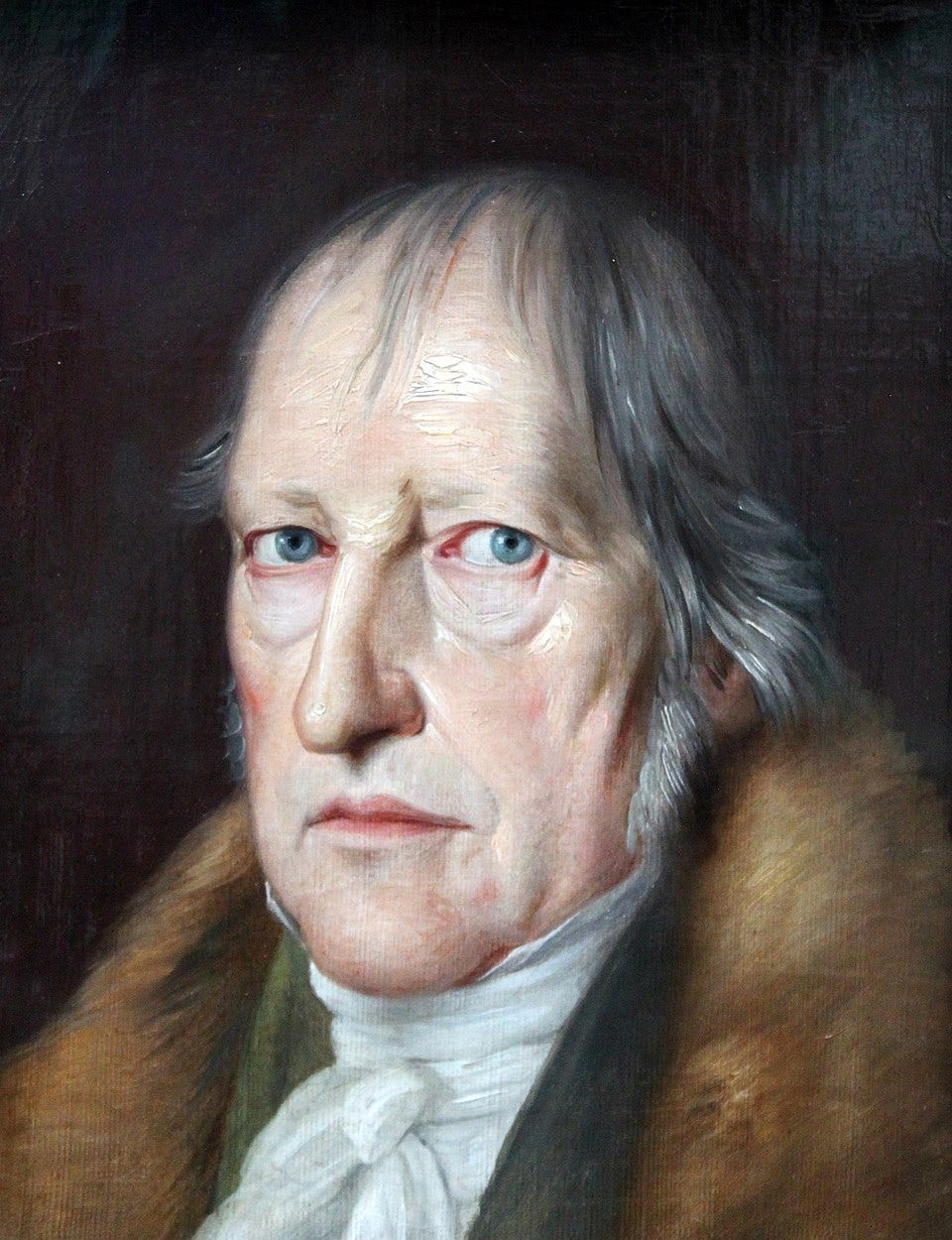
When will the history of consciousness end?
When we acquire absolute knowledge of ourselves, Hegel reckoned.
How will we know when we’ve got it?
When we arrive at the ‘terminus’ – the last stop in the journey of the human mind – when ‘knowledge is no longer compelled to go beyond itself’.
Absolute knowledge will be reached, says Singer, when the mind realises ‘that what it seeks to know is itself’.
By this Hegel meant that humankind will have advanced to a new realm of consciousness that has no need of enemies, no need of violence, war or revolution, and no master or slave – a realm rid of alienated souls.
—
In such a world, the dialectical wrangling of thesis, antithesis and synthesis that supposedly drives human progress – an idea originated by the German philosopher Johann Gottlieb Fichte (1762–1814) and not Hegel, as is often supposed – will be reconciled and dissolve.
Humankind will have arrived at Hegel’s ideal, conflict-free society.
From these sunny uplands, the human mind will be free to gaze on the past, present and future of consciousness, having reached the end point of the history of the mind, the self-realisation of oneself living in peace among other self-realised selves.
‘Thus Hegel,’ Magee concludes, ‘is unique among the great philosophers in that he regarded himself as . . . being himself the culmination of the world-historical process, the embodiment of reality’s purposes as regards understanding, the very incarnation of our enlightenment.’
In sum, Hegel’s history of consciousness described, first, the perception of external objects – rocks, snakes, thunder and so on; second, the startling recognition of an ‘other’ conscious self, a rival tribe; third, the enslavement of the weak by the strong; fourth, the realisation of the benefits of cooperation; and, finally, the absolute knowledge of mutually conscious selves dutifully coexisting in a world governed by reason.
—
Hegel conceived of this blissful state of freedom as a hierarchical society in which every person does his or her duty as a ‘harmoniously functioning part of the whole, freely serving the interests of a totality very much greater than himself’.
Thus the ‘end of history’ would not be a liberal democracy in the way the West idealises it and the philosopher Francis Fukuyama portrayed it.
Hegel’s idea of ‘freedom’ is akin to Kant’s concept of duty (one of their few areas of agreement): those who do their duty without coercion will be free citizens of a society of mutual cooperation, in which the conscious mind – the Geist – is the only reality.
—
Hegel’s great misstep was to locate the unfolding liberty of the mind in the history of the German people: namely, the Reformation and the rise of the Prussian state.
Other transformative moments in history – the Greek and Roman empires, the Renaissance, the French Revolution – were crucial pit stops along the path to the freedom of mind, he conceded, yet none achieved the liberty to which his philosophy of mind aspires.
The Greeks and Romans were slavedrivers, the Catholic Church controlled the conscience, the French Revolution began in exaltation and ended in the Terror. Only the Lutheran Reformation truly liberated the mind, by freeing the conscience to commune directly with God, he affirmed.
Hence, the German Lutherans embodied the highest manifestation of self-realisation, or what Hegel called the ‘world spirit’, the collective spirit of a people, or Volksgeist, which leavened every social and political institution, German culture, religion and philosophy.
‘The German nations,’ Hegel wrote, ‘under the influence of Christianity, were the first to attain the consciousness that man, as man, is free: that it is the freedom of Spirit which constitutes its essence.’
—
Hegel further blotted the appeal of his ideas by proposing Prussia as the highest manifestation of a ‘free people’.
This exposed him to ridicule: an autocratic regime that imposed strict censorship laws was hardly a model of ‘liberty’, however you conceived it.
Hegel’s idealising of Prussian autocracy fuelled the philosopher Karl Popper’s denunciation of Hegel as a father of tyranny; debate about this continues to this day.
Even if Popper based his critique on mistranslations or misunderstandings of Hegel’s idea of liberty, Hegel did himself no favours by describing ‘the state’ (meaning Prussia) as ‘the Divine Idea as it exists on earth’ and ‘the march of God through the world’.
In Hegel’s mind, the ideal state was the replication of God’s will on Earth: it embodied the ‘folk spirit’ and the ‘world spirit’ as ‘the realization of Freedom, i.e. of the absolute final aim, and it exists for its own sake’.
Hegel went further and saddled a ‘racial’ dimension to his idea of the ‘world soul’. If the English could boast of being ‘the men who navigate the ocean, and have the commerce of the world’, he wrote, then the German people represented ‘the spirit of the new world’.
Its aim was the realization of absolute truth as the unlimited self-determination of freedom.
—
Alas, the grandeur of Hegel’s history of the conscious mind curdles before our eyes in the crude nationalism of the Prussian state.
The story of the human mind thus ended in the head of the philosopher who wrote it. Or, to put it another way, the liberation of human consciousness reached a state of absolute self-knowledge in the mind of the German thinker who first thought of it.
If the story of the mind began and ended in Hegel’s head, what more was there to say after he passed away?
A great deal, as it happened: several ‘schools’ of Hegelianism survived their founder’s death and appropriated his ideas, forging two of the most terrifying belief systems in the history of humankind.
The Left Hegelians and the Right Hegelians claimed him, respectively, as the intellectual grandfather of communism – Marx appropriated Hegel’s theories and would apply them to class war; and of fascism – Popper and his disciples would portray Hegel’s idealisation of Prussia as a template for the totalitarian state.
Next Thursday, 5th February 2026: The spectre of Karl Marx
Selected sources and further reading:
Ameriks, K. (ed.) (2005) The Cambridge Companion to German Idealism, Cambridge: Cambridge University Press.
Arrington, R.L. (ed.) (2003) The World’s Greatest Philosophers, Oxford: Blackwell Publishing.
Ashton, A., Nicolacopoulos, T. and Vassilacopoulos, G. (eds) (2008) The Spirit of the Age: Hegel and the Fate of Thinking, Melbourne: re-press.org.
Hegel, G.W.F. and Brown, R.F. (1837) Hegel: Lectures on the History of Philosophy Vol. III: Medieval and Modern Philosophy, Oxford: Oxford University Press.
Hegel, G.W.F. (2019) The Collected Works of Georg Wilhelm Friedrich Hegel, Hastings UK: Delphi Classics.
Hösle, V. and Rendall, S. (transl.) (2013) A Short History of German Philosophy, Princeton NJ: Princeton University Press.
Kenny, A. (2006) An Illustrated Brief History of Western Philosophy, Hoboken NJ: Wiley-Blackwell.
Magee, B. (1998) The Story of Philosophy: The Essential Guide to the History of Western Philosophy, New York: DK Publishing.
Milne, D. (Spring 2002) ‘The Beautiful Soul: From Hegel to Beckett’, Diacritics, 32(1), pp. 63–82.
Popper, K. (1994) The Open Society and Its Enemies, Princeton NJ: Princeton University Press.
Singer, P. (2001) Hegel: A Very Short Introduction, Oxford: Oxford University Press.
Wood, A.W. and Hahn, S.S. (eds.) (2012) The Cambridge History of Philosophy in the Nineteenth Century (1790–1870), Cambridge: Cambridge University Press.
Imagine, next presser, any reporter asks, "Mr. President, what do you think about the alienation of consciousness and the liberated soul?"
Hegel based his entire body of philosophy on a profound error, the assumption that all or most men, and women, were willing and able to live a life of reason, an assumption which is inherently an act of unreason, the obvious is that that vast majority have no interest in living a life of "reason," however good (in theory) that might be,
The vast majority live lives of feeling, or passion, but not reason. Feeling is so much simpler than thinking.
What percentage of those living now have ever read anything of Hegal? Or even known something, however little, about Hegel? 0.01%? One in ten thousand? Maybe. Stop anyone on the street, or ask of any of your friends and relatives, What do you think of Hegel's philosophy?
Expect blank stares!
Unless you're friends and relatives are mostly philosophers, at least amateurs.
Hegel speaks to a very small audience, those few of us with some interest in philosophical thinking, sad, but true.
Ask President Donald Trump "What do you think of Hegel?" The answer, "What is a Hegel?"