
'Exceptional tranquility'
The summer before the storm, July 1914

What have we done? And why? Join me ‘On Earth As It Is’. Because only by understanding the past may we free ourselves from its tyranny.
‘A war will result in the uprooting of everything that exists’ - German chancellor Theobald von Bethmann-Hollweg, weeks before the guns of August, 1914
Next Thursday: The uses of Franz Ferdinand, dead
THE EUROPEAN SUMMER OF 1914 WAS WARMER and drier than usual.
The leisured classes took tea in their sun-rooms, went punting on the rivers, and attended their ritual balls and parties.
‘One lolled outside on a folding canvas chaise . . . One read outdoors, went on picnics, had tea served from a white wicker table under the trees,’ writes the cultural critic Paul Fussell, with that peculiarly American fondness for upper-class English social rites.
The poor waited on the rich, worked in the fields, mines and sweatshops, or begged. And they were kept below stairs, as usual.
The ‘Gilded Age’ continues to be resurrected in the twenty-first century, in popular screenplays, novels and films. The first episodes of the television series Downton Abbey and Parade’s End drew millions of viewers, enchanted by the aristocratic world of pre-war Oxbridge, winged collars and formal dress at dinner.
In those tranquil days, it seemed everyone was able to quote something from the classics. Perhaps the English officer was the most literate young man ever to don a uniform? Many read Shakespeare, the romantic poets and the Bible in the trenches. German soldiers were issued with copies of Nietzsche’s Thus Spake Zarathustra.
Many wrote poems, dared, as the French novelist Louis-Ferdinand Céline would write, ‘to compose quatrains in an abbatoir’. ‘Literature dominated the war from beginning to end,’ Fussell claims.
Reminiscences of those July days so often lapse into ‘mawkish and maudlin’ sentiments about a ‘sun-dappled and cultured civilisation’, warns the historian Hew Strachan.
And contemporary films and novels do draw on the experiences, or social types, of the romantic spirits of that lost era.
A recurring character reprises the life of the gallant young poet Siegfried Sassoon, Marlborough and Cambridge-educated, whom we glimpse in the summer of 1914 fresh back from fox hunting and about to play a game of county cricket. He’s an unquestioning youth, of good family, an ‘athlete and dreamer’ and a repressed homosexual, unrecognisable three years later as the broken man, old before his time, who would declare through his shell shock a ‘splendid war on the war’.
And here is Sassoon’s fellow officer, Wilfred Owen, whom we find teaching English to French boys in a village in Bordeaux that lovely July month, conceiving sweet poems with none of the restless agony of the deeply disturbed soldier who would write ‘Anthem for Doomed Youth’ (before he himself would die on the Western Front).
And here, the writer Robert Graves, similarly young and brilliant, and a stranger to the bitter old curmudgeon who would flay in the flintiest prose the politicians whose gift to his generation was the first day of the Somme (in Goodbye to All That).
French, German, Italian and Austrian writers were similarly swept up by the mood of the moment, as if a strange phantom in the air was beckoning them towards a fantastic unknown.
—
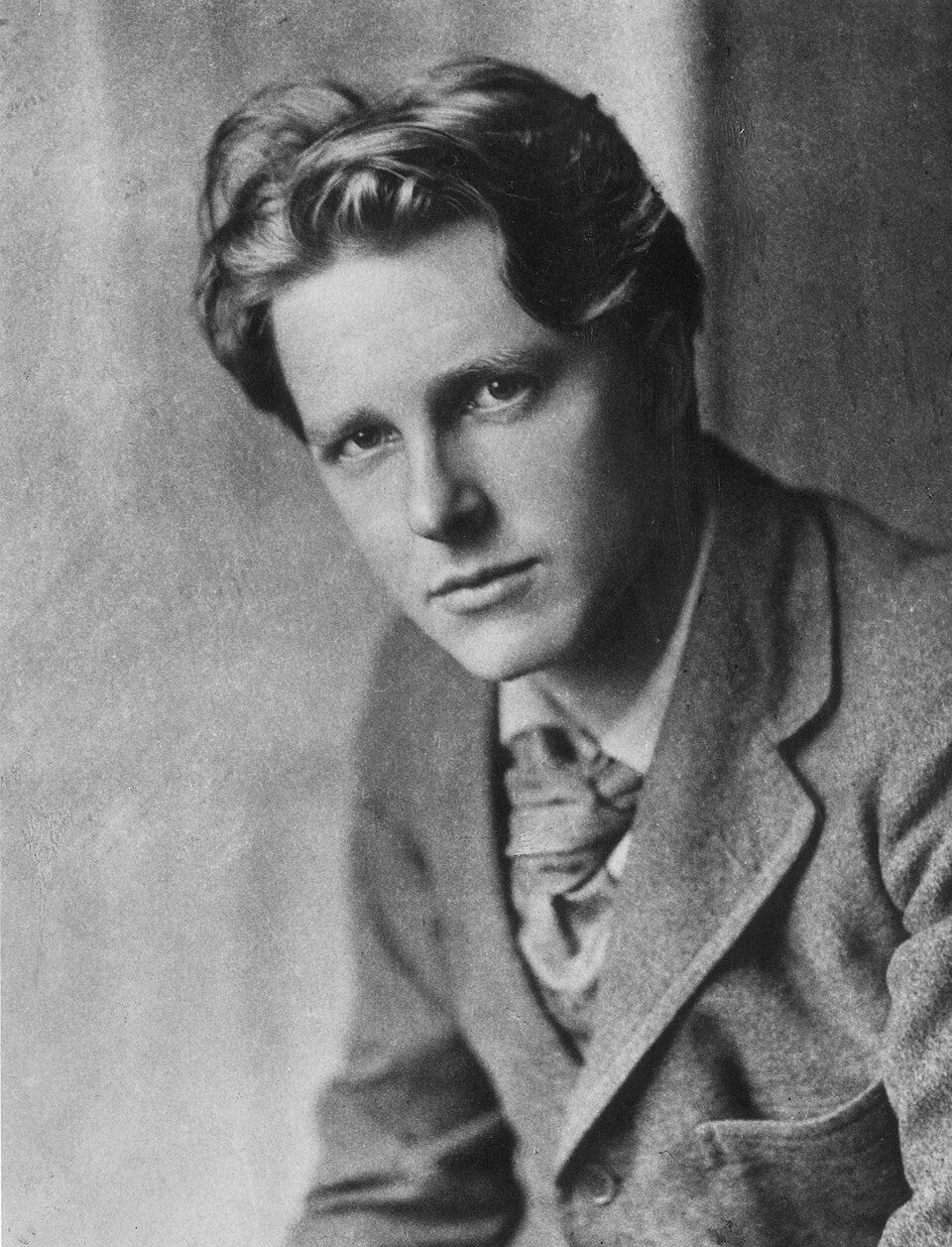
The name the English-speaking world romantically attaches to the Great War is that of the poet Rupert Brooke. The author of ‘The Soldier’ was ‘the handsomest young man in England’, said Yeats, ‘a golden warrior’, who was said to express the soul of England.
Brooke was a Cambridge educated, public-school dandy of the first order: ‘Oh my darling are you doing too much?’ Brooke wrote to an actor friend. ‘You looked so like a tired child last night at Drury Lane. If you knew how difficult it was for me not to take you in my arms, with Queen Alexandria and George Bernard Shaw . . . all looking on.’
Brooke’s death, in 1915, seemed to inter the spirit of the age, in the eyes of his Bloomsbury contemporaries and, most recently, in Alan Hollinghurst’s novel The Stranger’s Child. Less well known is the pathos of Brooke’s demise: he never saw combat and died of an infected mosquito bite on his way to Gallipoli.
These are the characters whose ‘types’ are so often used in the English-speaking world to evoke all that would perish in the Great War. That their battered lives should be deployed to symbolise a ‘lost generation’ is hardly their fault.
Yet it dangerously skews the picture. The lives of tens of millions of ordinary young men, with no literary pretensions or public-school vowels – British, French, German, Russian, Serbian, Austro-Hungarian, Indian, African, Australian, Canadian, Irish, New Zealand – would also be lost in ‘some corner of a foreign field’, remembered only by their families in village services, their remains buried in a distant graveyard, their letters gathering dust in library archives.
—
Some who survived the war would achieve immortality of a different kind. Céline, born Louis Ferdinand Auguste Destouches and decorated for bravery in 1914, would live to become one of the greatest French novelists, author of Journey to the End of the Night, regarded as one of the finest novels of the twentieth century.
Céline was also an open hater of the Jews and later, during WWII, an alleged Nazi collaborator. The brilliance of his prose and his care for the poor seems to have partly redeemed him.
It is an interesting, if futile, mind game to imagine how history would have looked had several of those who participated not survived the war.
The failed artist Adolf Hitler volunteered for the German infantry in 1914. He would prove recklessly brave, earning the Iron Cross twice, and survive to lead Germany to ignominious ruin in another world war 30 years later.
The scientist James Chadwick, interned in Germany in 1914, had been studying physics at the Technical University of Berlin. He would earn the Nobel Prize for Physics for his discovery of the neutron, critical to the construction of the atomic bomb used on Hiroshima.
Fellow physicist Erwin Schrödinger, who served as an officer in the Austrian Fortress Artillery during the war, would survive to pioneer the wave theory of quantum mechanics and formulate the paradoxical mind experiment known as Schrödinger’s Cat.
—
The tranquillity of those summer days disguised an extreme peril. Few realised that a meeting of Austro-Hungarian ministers had effectively declared war on Serbia on 7 July 1914, three weeks before the outbreak of European hostilities.
The warm July weather and the strange sense of something in the air drew people out of their homes. And some cities were far from peaceful. Huge pro-war rallies filled the streets of Berlin, Vienna and Belgrade. In the aftermath of Archduke Franz Ferdinand’s assassination, on 28 June 1914, lynch mobs prowled the streets of Vienna and Budapest.
Thousands clamoured for war against their perceived or imagined enemies, be they Slav, Teuton, Latin or Anglo-Saxon – ‘race’ was a much bigger factor in the war than many suppose.
When war was declared, in early August, there was open euphoria and laughter and scenes of strangers embracing, like old friends, impatient to get to the front. The war delighted a large, angry minority.
One of them was Adolf Hitler, who fell to his knees and ‘thanked heaven from an overflowing heart that it had granted me the good fortune to be alive at such a time’.
It is even claimed that those balmy days hastened the leaders’ decision to declare war, by enabling mass outdoor protests in favour of hostilities.
—
Were European leaders so impressionable? Were the people and the press – Britain’s all-powerful ‘public opinion’ – really willing war? Had public opinion compelled the German, French, Russian and British Governments to declare war?
No. A few thousand extreme nationalists, the jingo minority and a complicit media made a big noise but were hardly representative of the mainstream. The warmongering on display in Berlin, Belgrade, Vienna and Paris did not reflect the general mood in Europe.
Most French, British, Russian and German people did not want war, according to surveys, but they were powerless to stop it.
‘Militarism was far from being the dominant force in European politics on the eve of the Great War,’ concludes the historian Niall Ferguson. ‘On the contrary, it was in political decline . . . The evidence is unequivocal: Europeans were not marching to war, but turning their backs on militarism.’
The July street protests were unrepresentative of the feelings of millions of unasked mothers and fathers, wives and sisters, who dreaded the loss of their sons, brothers and husbands in the coming conflagration.
—
Europe’s rulers and political leaders knew something most of their people did not: a war was coming, a war more terrible than any in the annals of human history.
A few powerful old, aristocratic men brought war on the world behind closed doors, free from the scrutiny of an enfranchised public or an uncensored press. They later claimed they were ‘shocked’ by it and unable to prevent it.
Yet, three weeks before Germany invaded France, the German chancellor Theobald von Bethmann-Hollweg had said that he ‘expects that a war, whatever its outcome, will result in the uprooting of everything that exists’. He played a central role in its outcome, yet later claimed, as did other leaders, that he was helpless to stop it.
Similar premonitions of armageddon filled the minds of Europe’s rulers years before 1914. For most ordinary people, those premonitions began in July 1914.
Years later, they would look back on those summer days through the lens of a global conflict of unspeakable horror, loss and waste. And the contrast was unbearable. Understandably, they longed for that blissful peace, engraved in their minds as warm and sunbathed, as if idealising the weather would somehow suspend in aspic, if never quite retrieve, the ‘eminently pastoral’ pre-war world.
A hundred years on, we dare to call it innocence. Or we presume, in our dreadful knowingness, to call it madness, or callous indifference, at a time when the greatest war machines and largest land armies were mobilising to destroy their world. But that is to project the opening blows of the bloodiest century back on a stranger, simpler time, before the guns of August blew it apart forever. The simple truth is that most people, as always, did not know what was going to happen next.
Next Thursday, 18 June 2026: The uses of Franz Ferdinand, dead
Selected sources and further reading:
Brooke, Rupert, ‘The Soldier’, Poetry Foundation
Céline, Louis-Ferdinand, Journey to the End of the Night, Alma Classics, London 2012
Eksteins, Modris, Rites of Spring: The Great War and the Birth of the Modern Age, Houghton Mifflin Harcourt, Boston 2000
Ferguson, Niall, The Pity of War: Explaining World War I, Basic Books, New York 2000.
Fest, Joachim, Hitler, Mariner Books, Boston 2002.
Fussell, Paul, The Great War and Modern Memory, Oxford University Press, USA 2000
Jones, Nigel, Rupert Brooke: Life, Death and Myth, Richard Cohen Books, London 1999
Nesbitt, Cathleen, A Little Love and Good Company, Faber & Faber, London 1975
Strachan, Hew, The First World War, Penguin, London 2005
Strachan, Hew, The First World War: Volume I: To Arms, Oxford University Press, USA 2003
Ullrich, Volker, Hitler: Ascent, 1889-1939 (trans. Jefferson Chase) Bodley Head, London 2016.
This essay is an edited extract from my book 1914: The Year the World Ended published by Penguin Random House (UK and Australia).
This calm before an incredible storm. I always thought there was a huge desire among the young to be part of ‘the big show’ as it was called. I understand that the mothers and fathers knew what would be coming - and may have feared it - but there seemed to be little opposition to it until the death toll started rising exponentially. So I ask if there really was a strong anti-war feeling at the beginning?