
Mencius v Xunzi
Were we born to love or hate one another?

This is Who made our minds?, my Thursday essay probing the greatest, cruellest and most beautiful minds of the past 5,000 years, inspired by my book, The Soul: A History of the Human Mind (Penguin 2024). Next week: Spinoza’s God
ARE HUMAN BEINGS inherently good or evil?
That question troubled Confucius’ heirs, because the Master left little guidance on the matter and had not dwelt on questions of ‘the soul’ and the ‘inner self’.
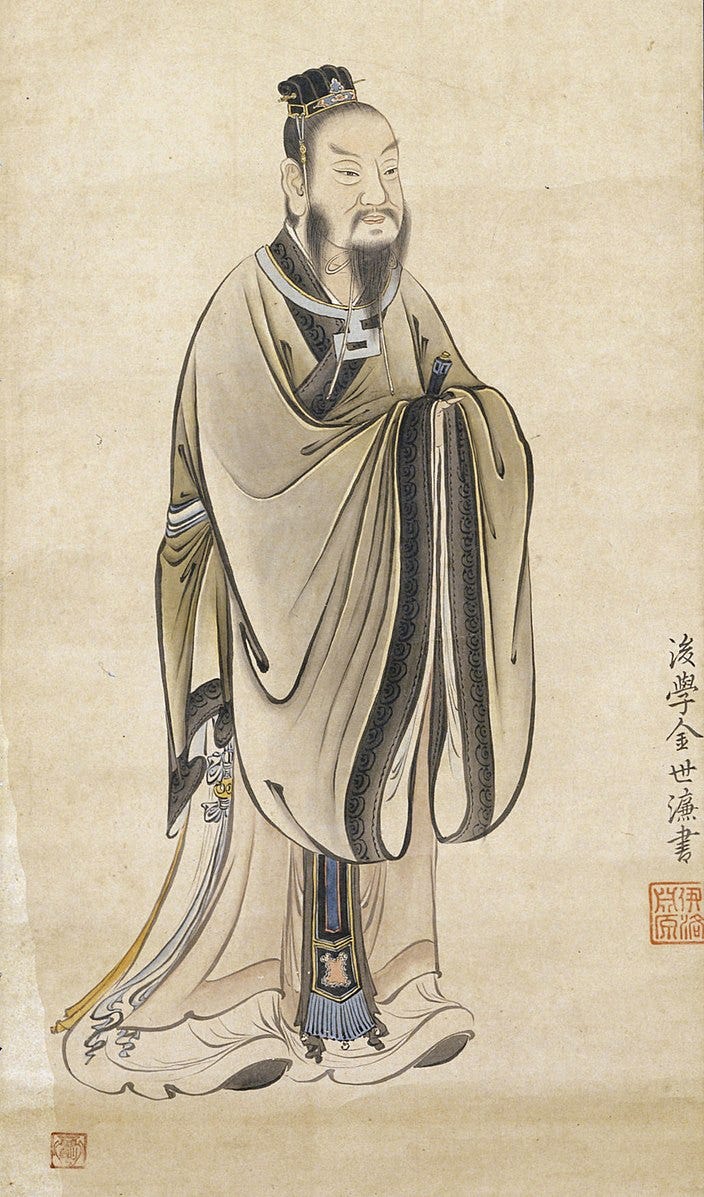
The Confucian idea of the ‘self’ was relational: that is, you were defined by your relationships with others, not by your qualities as an individual.
The Confucian self thus benefited from morally good relationships and suffered from bad or ‘toxic’ ones.
A Confucian did not ask, ‘Who am I?’; rather, he asked, ‘Who am I to others?’ This turned the question of inherent good and evil into one of inter-relational perceptions. In ancient China ‘identity’ was a philosophical issue, not a theological or cultural one.
And the perception of whether you were good or evil had serious political consequences. If society agreed that humans were inherently benign, then the state should be free to relax its laws and punishments, and offer rewards and incentives. If society believed we were inherently malign, then the state should impose harsh laws and punishments to control our worst instincts.
—
Two of Confucius’ most gifted intellectual heirs were diametrically opposed on the question of whether human beings were inherently good or evil.
Mencius (372–289 BCE) was a ‘tender-minded’ philosopher who thought humans were innately good.
Xunzi (310–c. 238 BCE) was a ‘tough-minded’ philosopher who believed humans were innately bad.
For centuries, Mencius was the more influential, not least because his beautiful prose seduced the ruling Song Dynasty. The sun of Mencius ‘totally eclipsed’ Xunzi’s unpolished thoughts, wrote the sinologist D.C. Lau. In recent centuries, however, Xunzi has clawed his way back to the front ranks of Chinese thinkers.
Their thoughts transcend their age and ask questions of us all, so let’s explore them.
Mencius wrote Si Shu (the ‘Four Books’), and was often called the ‘Second Sage’ – second to Confucius, that is. He believed that human beings were born good, or xing shan (literally, to ‘do good’).
None of us was born in evil, he believed. The idea of original sin would have seemed ridiculous to Mencius.
His comforting philosophy drew on the deep well of love he felt for his mother. For Mencius, it was axiomatic that a child who loved his or her parents would reciprocate that feeling, and feel love for others in adulthood.
Mencius believed the ‘heart’ (xin) was the well of goodness in humankind. He meant that the heart was the literal source of virtue and love, and not a sentimental metaphor for it.
The heart was the seat of cognition, emotion and affection. It manifested those qualities through ren (sympathy and compassion), yi (moral sense or rightness), li (respect for traditional codes of behaviour) and zhi (wisdom).
The heart was the mind, in Mencius’ philosophy. Man possessed a ‘thinking heart’, he believed. ‘The organ of the heart can think,’ he wrote. A man who fully realised the power of his heart ‘understands his own nature, and a man who knows his own nature will know Heaven’. The heart, then, was the seat of human character.
—
One source of Mencius’ sunny philosophy was his proto-democratic interpretation of the emperor’s ‘divine right’ to rule.
Like Confucius, Mencius felt profoundly opposed, morally and philosophically, to the world in which he lived.
The fiefdoms that comprised the landmass of China in the fourth century BCE were slowly amalgamating, in accordance with the ‘legalistic’ doctrines of a philosophical school that viewed mankind as purely egoistic and driven solely by the thought of reward and punishment.
The Shang Dynasty (which ruled between the sixteenth and eleventh centuries BCE) embodied this brutalist system of belief. Many of their rulers abused the Mandate of Heaven, or ming – that is, the divine right of kings to rule – through complacency, indolence and corruption, leading to their collapse.
The early rulers of the Zhou Dynasty (1046– 256 BCE) who succeeded the Shang decreed that never again should an emperor abuse his mandate. A ruler must be constantly vigilant to avoid corrupting himself and his people.
Mencius seized on this idea. Ordinary men had a share in ming, he insisted; the divine right to rule was not the preserve of the ruling house. When the Mandate of Heaven fell to Earth, it brought humankind a set of guidelines on how to live a truly good life. Heaven, then, enjoined men and women to rule themselves and to be good at heart.
Without a ‘thinking heart’, Mencius insisted, human beings were prey to their bestial instincts, such as ‘food and sex’ (as also noted in Confucius’ Analects). If so, then men were no better than animals. Such squalid creatures were not worthy of ming. They were as depraved as a dynasty that had lost its ming. The human heart, then, was analogous to a benevolent regime that was sensitive to the suffering of others. ‘With such a sensitive heart behind compassionate government,’ Mencius wrote, ‘it was as easy to rule the Empire as rolling it on your palm.’
—
Mencius offered an example of a situation that he believed proved the inherent goodness of humankind. If a man encountered a young child on the verge of falling into a well, he would rush to save the child out of innate goodness. Shame at the thought of neglecting the vulnerable would spur him to act, moved by his compassion for the child, and not a vain desire to win the good graces of the parents, or the praise of his fellow villagers.
This example and others led Mencius to identify four emotional strengths of the human heart: compassion, shame, courtesy and modesty, and right and wrong. Compassion inspired benevolence. Shame forged a sense of duty. Courtesy and modesty fostered a respect for ritual. And knowledge of right and wrong brought forth wisdom. Men devoid of these qualities were ‘not human’, and a ruler who lacked them was unfit to rule. Without them, the regime, like the Shang Dynasty, would fall.
From this flowed some of Mencius’ better-known epigrams:
‘Win the people and you will win the Empire…’
‘There is a way to win the people; win their hearts and you will win the people.’
‘There is a way to win their hearts: amass what they want for them; do not impose what they dislike on them. That is all.’
Being ‘true to yourself’ was pure Mencius: ‘There has never been a man totally true to himself who fails to move others,’ he believed. Mencius found ‘no greater joy’ than in self-examination.
The degradation of character Mencius likened to the defoliation of a mountainside, a metaphor that aligned the state of the natural world with the human soul. A mountain denuded of trees was like a soul bereft of its true heart.
Mencius’ benign vision of humankind led him to rework Confucius’ negative Golden Rule, which had stated: ‘Do not do to others what you do not wish to be done to yourself.’
Mencius turned this into an active, positive choice: ‘Try your best to treat others as you would wish to be treated yourself, and you will find that this is the shortest way to benevolence.’
Mencius had thus anticipated the core teaching of Christianity three centuries before the coming of Christ.
—
Xunzi violently opposed Mencius’ philosophy, entitling his best-known treatise Xing E, or ‘Human Nature Is Evil’.
Mankind was irredeemably base, selfish, greedy and malevolent, Xunzi believed. He dismissed Mencius’ story of the man who saved the child from the well as a chance occurrence, by no means universal.
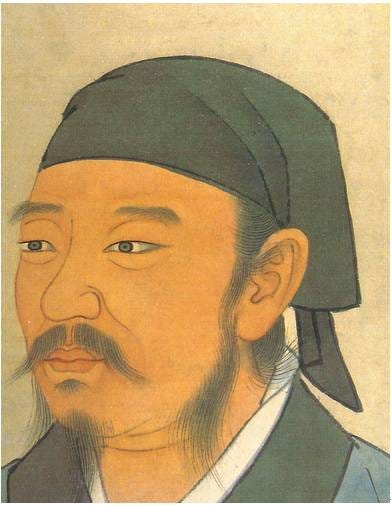
Two brothers fighting over money, and who were prepared to do almost anything to get it, was a clearer portrait of human nature, Xunzi proposed. Greed and covetousness tended to dominate Xunzi’s catalogue of evils.
Since man’s true nature is evil, Xunxi wrote, goodness was only achievable through conscious effort:
‘The nature of man is such that he is born with a fondness for profit . . . He is born with feelings of envy and hate . . . Hence, any man who follows his nature and indulges his emotions . . . will violate the forms and rules of society, and will end as a criminal.’
Only harsh punishment and adherence to ritual (li) would control man’s malign nature, Xunzi concluded, anticipating the philosophy of Thomas Hobbes by 1,800 years.
—
Xunzi excelled at appropriating the thoughts of other thinkers and folding them into a philosophy that concurred with his austere brand of Confucianism.
Among his ‘sources’ were two champions of ‘legalist’ doctrine, Shen Buhai and Shen Dao, the famous Taoist Zhuangzi, the Mohist thinker Mozi and the dialectician Gongsun Long.
Their ideas frequently clashed with Xunzi’s, and they leaven his work like legions of little ghosts nagging to be freed from the cage Xunzi has entrapped them in.
Xunzi also mastered the art of turning his opponents’ arguments against them – and Mencius was his biggest target.
If Mencius was right, Xunzi argued, then men need only look into their hearts for the correct path. And if that were possible, then what use were the sages? If men were innately good, what use were laws? Wasn’t even Confucius, the great teacher, redundant?
Without laws and rituals, Xunzi contended, men were prey to their vicious natures. If they were free to follow their innate ‘fondness for profit’ and ‘feelings of hate and dislike’, then ‘lasciviousness and chaos will arise, and ritual and yi, proper form and order, will perish’.
‘If it were like this, then the strong would harm the weak and take from them. The many would tyrannize the few . . . One would not have to wait even a moment for all under Heaven to arrive at unruliness and chaos and perish. Looking at it in this way, it is clear that people’s nature is bad, and that their goodness is a matter of deliberate effort.’
The messy psychological truth is that Mencius and Xunzi were both right, and the human mind is a complex blend of benign and malign motivations. The question of whether moral or immoral impulses are innate in us all, or taught through experience, still baffles psychologists and neuroscientists. We shall continue journeying to those extremes, to explore the best and worst in human nature.
Next Thursday, 28th November 2024: Spinoza’s God
Selected sources and further reading:
Allinson, R.E. (1992) ‘The Golden Rule As the Core Value in Confucianism & Christianity: Ethical Similarities and Differences’, Asian Philosophy, 2(2), pp. 173–85.
Chen, Y. (2013) Confucianism as Religion: Controversies and Consequences, Boston MA: Brill.
Confucius and Confucian scholars, and Legge, J. (transl.) (2016) Four Books and Five Classics of Confucianism (The Four Books: Great Learning, Doctrine of the Mean, Analects, Mencius; the Five Classics: Classic of Poetry, Book of Documents, Book of Rites, I Ching, Spring and Autumn Annals), Delphi Collected Works of Confucius, Hastings UK: Delphi Classics.
Fingarette, H. (1972) Confucius: The Secular As Sacred, New York: Harper Torchbooks.
Goldin, P.R. (1999) Ritual of the Way: The Philosophy of Xunxi, Chicago: Open Court Publishing Company.
Howard Smith, D. (3 September 1958) ‘Chinese Concepts of the Soul’, Numen, 5(3) pp. 165–79.
Howard Smith, D. (1973) Confucius, Temple Smith.
Hsün, T. and Burton, W. (transl.) (1963) Hsün Tzu: Basic Writings, New York: Columbia University Press.
Lai, K. (2017) An Introduction to Chinese Philosophy, Cambridge: Cambridge University Press.
Li, C. (2006) ‘The Confucian Ideal of Harmony’, Philosophy East and West, 56(4), pp. 583–603.
Li, C. (2008) ‘The Philosophy of Harmony in Classical Confucianism’, Philosophy Compass, 3(3), pp. 423–35.
Loewe, M. (2012) ‘Confucian Values and Practices in Han China’, 98, T’oung Pao (International Journal of Chinese Studies).
Mencius and Lau, D.C. (transl.) (2004) Mencius, London: Penguin.
Xunzi and Dubs, H. (transl.) (1966) The Works of Hsüntze, Taipei: Chengwen.
Xunzi and Knoblock, J. (transl.) (1994), Xunzi: A Translation and Study of the Complete Works, Redwood City CA: Stanford University Press.