
War by train timetable
In 1914 the European train was like a slow-moving atomic bomb. The first to the front-line was supposed to win the war . . .

What have we done? And why? Join me ‘On Earth As It Is’
‘The proliferation of European railways was an arms race, as lethal in intent as the nuclear arms race in our own time.’
Next Thursday: Schlieffen’s Apocalypse
FAR FROM BEING A SHOCK to the rulers of European civilisation, the war that erupted in August 1914 was widely expected, rigorously rehearsed, immensely resourced and meticulously planned.
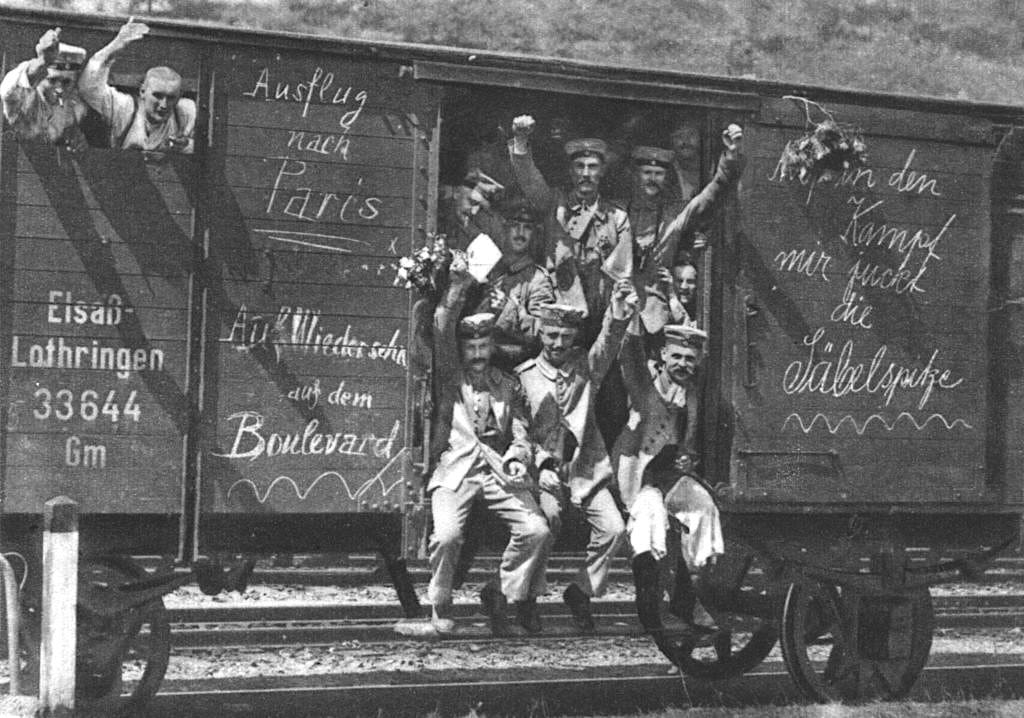
None then realised it would become a world war lasting four years. The politicians and generals would have thought you insane had you told them it would condemn to death or scar for life some 40 million young men.
Most people in power, and many ordinary taxpayers, hoped it would be over in a few short months. Perhaps they were ‘the sleepwalkers’ the historian Christopher Clark intended by the title of his otherwise excellent history.
No leader of Germany, France, Britain and Russia ‘sleepwalked’ to war. They planned a conflagration they knew would engulf all of Europe. They planned it without any accountability to the people whose taxes financed it.
Their plans were drawn up in the strictest secrecy and shared only with the innermost military circles of the major powers. The lives of millions were in the hands of a few old warriors with no obligation to inform their parliaments.
Nor, as historian John Keegan shows, did any of the belligerent nations have an integrated national security policy, which drew together politicians, the armed forces and the intelligence services.
Britain was an exception, in part, to this picture of covert military planners drawing up the destruction of Europe with little or no civilian restraint. There, politicians, commanders and civil servants served on a Committee of Imperial Defence (CID). This created a dialogue between the generals and admirals who dominated the CID, and the country’s elected representatives.
Compare that to the near-Byzantine situation in Germany, where war planning belonged exclusively to the Great General Staff – a situation resulting from the decision by the Kaiser and army chiefs in 1889 to remove the German Parliament and the War Ministry from any involvement in war planning.
This meant that Germany’s army officers had extraordinary powers over when – and indeed whether – their country went to war, with little if any accountability to the German parliament or the German people.
President Donald J. Trump and his generals are waging war in Iran in the same way: without any accountability to the elected civilian leaders or (by extension) the American people. The US administration is spending billions of dollars of taxpayers’ money on a war they ‘planned’ and executed without the consent of Congress or the support of American taxpayers.
—
Crucial to every war plan in Europe was the railway.
The railroad accommodated the generals’ grandest and maddest ambitions.
The transformative invention of the nineteenth century changed the way future armies would be deployed and supplied. Railways greatly reduced the time between the order to ‘mobilise’ – i.e. to move an army to the front – and the actual attack.
By the 1900s, the European rail networks were able to deliver millions of troops to distant battlegrounds within days. Mobilisation thus involved the cooperation of the whole nation.
The scale of the logistical exercise was staggering. According to planners’ calculations, to mobilise the German Army would require, by 1914, 20,800 trains, moving 2,070,000 men, 118,000 horses (each eating ten times as much as one man) and 400,000 tonnes of materiel.
France would require 10,000 trains and Britain 1000 trains, to mobilise their armies, according to the historian David Stevenson - a reflection of their size relative to Germany’s at the outbreak of war in 1914.
—
This mobilisation stage would deliver armies to their forward depots, from where they would be entrained to the rail-heads near the frontier zones.
Here, the troops would disembark and march the remaining distance to the front lines.
Faster trains and better networks offered both a great opportunity and a lethal threat: the opportunity to send armies direct to an enemy’s border, and the threat that the enemy’s train system would get there first.
Deciding to send the first train was comparable, in a way, to pushing the nuclear button in our time. Both triggered war – the former within days, the latter almost instantly.
The railway system had thus set the conditions for a logistical race across Europe. The winner would be the country able to deliver the maximum number of men, arms and supplies to the front lines as quickly as possible.
Once the trains were on their way, they would be difficult – though not technically impossible – to stop, since their departure would provoke the departure of the enemy’s trains down the opposing lines.
—
The historian A. J. P. Taylor famously claimed that the rail timetables ‘imposed’ war on the statesmen of Europe.
He meant the new rail timetable thrust an ‘inadvertent’ war on governments who were helpless to stop ‘runaway trains’.
These ‘runaway trains’, packed with troops, bristling with guns and bombs, and hurtling towards the front lines, made war inevitable - so long as the trains ran on time!
—
Who had the power to send, or stop, the trains? Nominally, the war offices of the warring governments. In practice, however, the generals would play the decisive role.
At least until 1911, the British War Office, exceptionally, had had little influence over the construction and management of the British rail network, which was largely run by private companies.
Under the 1871 Regulation of the Forces Act, the government awarded itself the power to commandeer the railways at mobilisation, and the War Railway Council gave the rail companies the information they required to ‘begin timetabling’. But, right up to 1914, there was little or no liaison between the British armed forces and the railway companies.
The British muddled through until they found the right man to change this dire situation, in the form of Sir Henry Wilson, the War Office’s withering director of military operations. In 1910 he persuaded the prime minister Herbert Asquith to speed up rail deployments. Britain’s rail network soon grew into the densest in Europe.
French railways were partly nationalised in the 1900s. The French Government took ownership of the rail bed, the network and one of the six railway companies. And they got to work building the network.
This fulfulled the wishes of the French armed forces. The French general Victor-Bernard Derrécagaix had written in 1885 that the country’s first priority must be ‘to cover its territory with a network of railways which will ensure the most rapid possible concentration’ of arms and men.
Bismarck nationalised most German railways after 1879, to coordinate them with military demands, as did Austria-Hungary between 1892 and 1905. Helmuth von Moltke, chief of the General Staff from 1906, exhorted his countrymen to build more railways, not fortresses.
Tsarist Russia had also nationalised most of its railways by 1914, a given motive being the poor performance of private rail operators in the war with Turkey in 1877–78. In fact, the Russians were preparing for ‘war by train timetable’ like the rest of Europe.
—
The imperative of getting as many men to the front as quickly as possible spurred a race to build the best and most flexible rail networks.
Between 1870 and 1914, European track length tripled, from 105,000 to 290,000 kilometres.
Steel rails replaced iron, and double-tracked lines rapidly replaced single-tracked ones.
By 1914, only 27 per cent of Russia’s train lines were double-tracked, compared with 38 per cent of German lines, 43 per cent of French and 56 per cent of British. In Russia, 14 trains a day rattled along a single-tracked line, and 32 along a double.
These may seem boring statistics, but consider what they meant: at least twice the number of trains, carrying twice the number of soldiers, bearing down on a distant front line, there to be disgorged and sent straight into battle.
—
The proliferation of European railway networks was an arms race, as lethal in its intent as the nuclear missile race in our own time.
In the 1900s, the race was well and truly on. France and Germany rushed to construct more lines running to their common border. In 1870, the Germans had nine lines to the border and the French had four. By 1886, France had 12 and Germany still nine; and by 1913 France had 16 and Germany, 13.
By 1914, each French line could deliver three army corps (80,000–135,000 men) to a station behind the deployment area, where the troops would detrain and march to the front.
Throughout the 1900s, the French and German Armies were constantly testing and improving their rail networks in line with their war plans.
In 1911, Joseph Joffre, newly appointed chief of the French General Staff, ordered a complete revision of the French war plan. The new ‘Plan XVII’ cut the time taken to concentrate his forces at the front lines to two days and allowed him to shift the detraining point of each army corps ‘forwards, backwards, and even sideways, along the transverse lines’.
German and Russian planners were similarly investigating how railways would allow the fast and flexible mobilisation of their forces.
—
The most ominous developments were in Russia. Until 1908, its immense rail network was in poor shape: its tracks rusting and broken, its trains old and badly maintained.
Then, as the country recovered from the loss to Japan, in the 1904-05 war, the Russian Government started to regenerate the network. By 1910, it had laid ten new links to the German border. In 1912, it decided to invest in a massive new network: 900 kilometres of new track were laid that year.
That was just the start. Russia’s General Staff aimed to achieve two goals: to mobilise the millions of men living in the interior of Russia’s vast land mass; and to slash the time between the start of mobilisation and a putative invasion of Germany.
Their ambition was to deliver more than a million men to combat positions on the 15th day or earlier after mobilisation.
A second Franco-Russian loan, of 2.5 billion French francs, agreed in December 1913, gave the Russian war minister Vladimir Sukhomlinov the money he needed to lay a further 5330 kilometres of strategic lines over four years, between 1914 and 1918, extending deep into the country.
Its huge railway project would place Russia in a position to annihilate not only Germany but all of continental Europe.
That prospect horrified the German Government. Helmuth von Moltke the Younger described the French rail loan as ‘one of the most sensitive strategic blows that France has dealt to us since the war of 1870–71’.
The convergence of the Russian and French railway systems on the German borders would create ‘a decisive turning point to Germany’s disadvantage’.
—
By 1914, then, the tentacles of the French, German and Russian railway systems were literally plugged into their common borders, like so many suction-capped tentacles, ready to disgorge millions of soldiers along a huge front.
In this light, the new railway networks, as historian David Stevenson shows, were not only a precondition for a European war; they made almost inevitable Germany’s plans to fight a preventive war at a future point – that is, to strike sooner rather than allow Russia the time to build an unconquerable, highly mobile army.
The planet had never experienced a war on such a scale, the German planning for which devolved upon a man of singular authority in the Prussian hierarchy armed with a chilling vision for humankind. His name was Alfred von Schlieffen.
Next Thursday, 14 May 2026: Schlieffen’s Apocalypse
Selected sources and further reading:
Kaiser, David E., ‘Germany and the Origins of the First World War’, The Journal of Modern History, Vol. 55, No. 3 (September 1983), The University of Chicago Press, pp. 442-474
Keegan, John, The First World War, Vintage, London 2000
Kern, Stephen, The Culture of Time and Space 1880–1918, Harvard University Press, Cambridge, Massachusetts 2003
Moltke, Helmuth von, Essays, Speeches, and Memoirs of Field Marshal Count Helmuth von Moltke, Vol. 1 of 2 (Classic Reprint), Forgotten Books, Hong Kong 2012
Stevenson, David, 1914–1918: The History of the First World War, Penguin, London 2005
Stevenson, David, Armaments and the Coming of War: Europe, 1904–1914, Oxford University Press, Oxford 2000
Stevenson, David, ‘War by Timetable? The Railway Race before 1914’, Past & Present, No. 162 (February 1999), Oxford University Press on behalf of the Past and Present Society, Oxford, pp. 163-194
Taylor, A. J. P., ‘Accident Prone, or What Happened Next’, The Journal of Modern History, Vol. 49, No. 1 (March 1977), The University of Chicago Press, pp. 1-18
Taylor, A. J. P., [Untitled], The English Historical Review, Vol. 69, No. 270 (January 1954), Oxford University Press, pp. 122-125
Taylor, A. J. P., War by Timetable: How the First World War Began, Endeavour Press, London 2013
[This essay is an edited extract from my book 1914: The Year the World Ended published by Penguin Random House]
Interesting when we look at history the amount of 'other' thongs play a vital, and often overlooked role.
I’d be interested to know which country brought the most amount of soldiers to the front - the quickest. I would presume Germany. Two million men sent to France and Russia in just weeks?