
How to plan a holocaust
Ask Alfred von Schlieffen, author of the deadliest document in history

What have we done? And why? Join me ‘On Earth As It Is’
‘At the given moment, the drawbridges are to be let down, the doors are to be opened and the million-strong armies let loose, ravaging and destroying, across the Vosges, the Meuse, the Niemen, the Bug and even the Isonzo and the Tyrolean Alps. The danger seems gigantic.’ - Count Alfred von Schlieffen, author of the Schlieffen Plan
Next Thursday: Delusions of a love-sick Austrian boy
A WAR PLAN THAT GLORIFIES those for whom it is written, that aggrandises the victory implicit in its design, carries an awful potency.
It sits in the mind, and on the desk, gathering a terrific animus, as though it might burst to life at any moment. It anchors ideas. It reconciles hostile camps. It lures the powerful. It conjures in the minds of commanders images of themselves adorned in medals. Its dormant power is spellbinding.
By laying the spectacle of the mobilisation of a million men and thousands of machines on the page, the war planners had somehow prefigured their own victorious destiny. By drawing together the dreams and careers that depended on it for their fulfilment, such a plan may even be said to prescribe, and in a sense foretell, the very outcome for which it was drafted. Such a plan becomes, in certain febrile, warlike minds, a self-fulfilling prophecy.
By 1905, Germany had conceived of such a plan.
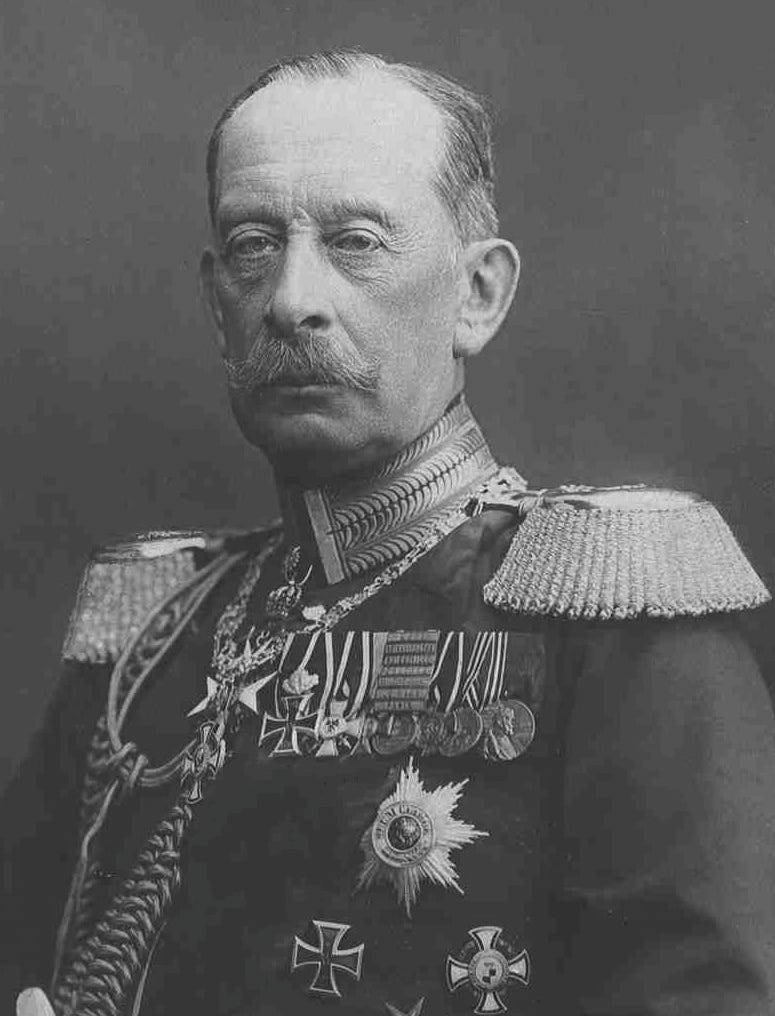
They called it the Schlieffen Plan, the work of Count Alfred von Schlieffen, a severe and unyielding Prussian general who had served as chief of the Great General Staff of Germany since 1891 and was now nearing retirement.
The plan took him eight years to draft, between 1897 and 1905, and was annually updated thereafter. Schlieffen, and the small group of senior officers under his command, continually tested, probed and revised his great work.
They laboured in secret, with no accountability to the German Government who did not in fact know the extent of the plan until 1912. Civilian meddlers were unwelcome in the inner sanctum of Prussian military power. German young men had no idea of the scale of the war they would soon be ordered to join.
The Schlieffen Plan prescribed a vast two-front conflagration, in which the bulk of Germany’s forces would attack and defeat France within the extraordinary deadline of 42 days. Germany would then regroup and turn its full strength eastward, defeat Russia, and conquer all of Europe.
The ‘Schlieffen Plan’, concludes the historian John Keegan, ‘was the most important government written in any country in the first decade of the twentieth century; it might be argued that it was to prove the most important official document of the last hundred years, for what it caused to ensue on the field of battle, the hopes it inspired, the hopes it dashed, were to have consequences that persist to this day.’
—
To this day, controversy surrounds the plan: did it prescribe a ‘defensive’ or an ‘offensive’ war? Or a ‘preventive’ war? Was it even a ‘plan’, or rather a grand scenario? Could the 1905 version be applied to the world of 1914?
To answer those questions, it’s worth knowing a little about its architect.
Born in 1833 to an old Prussian family, Schlieffen’s first choice was law. He had shown little interest in the military until he was selected as an officer cadet after completing his year of compulsory military service.
Thus began a 53-year career in the Prussian Army, during which Schlieffen served as a staff officer in the Austro-Prussian War (1866) and led a small force in one of the most exacting campaigns of the Franco-Prussian War (1870–71). These were brief interruptions to a long career as a desk-bound topographical expert, staff officer and theoretician. From the desks of such men are entire nations obliterated.
Schlieffen lived and breathed the strategic planning of the German Army. ‘He was a man without hobbies,’ Keegan writes. Schlieffen found relaxation in reading military history to his daughters.
He was not a politician’s soldier and had no need to be one at a time when the Prussian generals tended to overrule the politicians. He had no truck with drawn-out diplomacy and little patience with the political process.
He thought of war – as did many Prussian generals – as the noblest solution to his country’s problems. He thought in grand visions and big pictures, then furnished them down to the finest details.
—
Central to his thinking, as Schlieffen approached retirement, was a near-obsessive belief in the primacy of force: might, in this unholy scenario, was indubitably right.
The overwhelming power of the Prussian Army would solve the threats the German high command imagined all around them. Berlin saw in Schlieffen the perfect man to draw up a military solution to Germany’s fears of gradual encirclement.
The nation’s military leaders had warned Kaiser Wilhelm II that hostile powers were gradually squeezing the Fatherland.
In response, the Kaiser and the Prussian General Staff turned to Schlieffen’s conception of a war fought on two vast fronts, in the east and west. It was a grand recipe for a sudden, ferocious charge out of the besieged German fortress: such was the mentality of Germany’s leaders in the first decade of the 20th century.
—
The Schlieffen Plan would serve as a kind of covenant: all future military strategies would fall into lock step with the ideas of the German General Staff’s longest serving and most respected chief. Schlieffen’s influence ensured it was the only plan they had.
The plan’s success hinged on three critical factors: the slower mobilisation rate of the Russians; the free passage of German troops through Belgium; and the efficient running of the German railways to supply the troops.
Their final production was macabre in its fastidious attention to detail: the rate of the hourly advance, the towns that must be taken by certain times, the likely body count of the battles, and, of course, the train timetables: how many men, arms and supplies could be entrained to marshalling points at certain times.
—
By late 1905, Schlieffen had compressed his very big and very aggressive ideas into a realisable design for war.
The Germans clung to their claim that this would be a ‘defensive war’ right up until the guns of 1914.
This plea lost credibility on two counts: first, every one of the great powers claimed to be preparing to fight a ‘defensive war’, thus depriving the phrase of any meaning; second, Schlieffen’s conception was surely the most offensive ‘defensive war’ ever laid out on a map of Europe.
The most ingenious way out of this semantic trap was to call it a ‘preventive war’: i.e. to prevent the rise of a future, unbeatable Russia by destroying the Russian forces now.
In other words, to launch a war according to the assumption that Russia would mount a massive invasion of Germany within a few years – probably in 1917, when Russia’s combat-ready army was scheduled to reach two million.
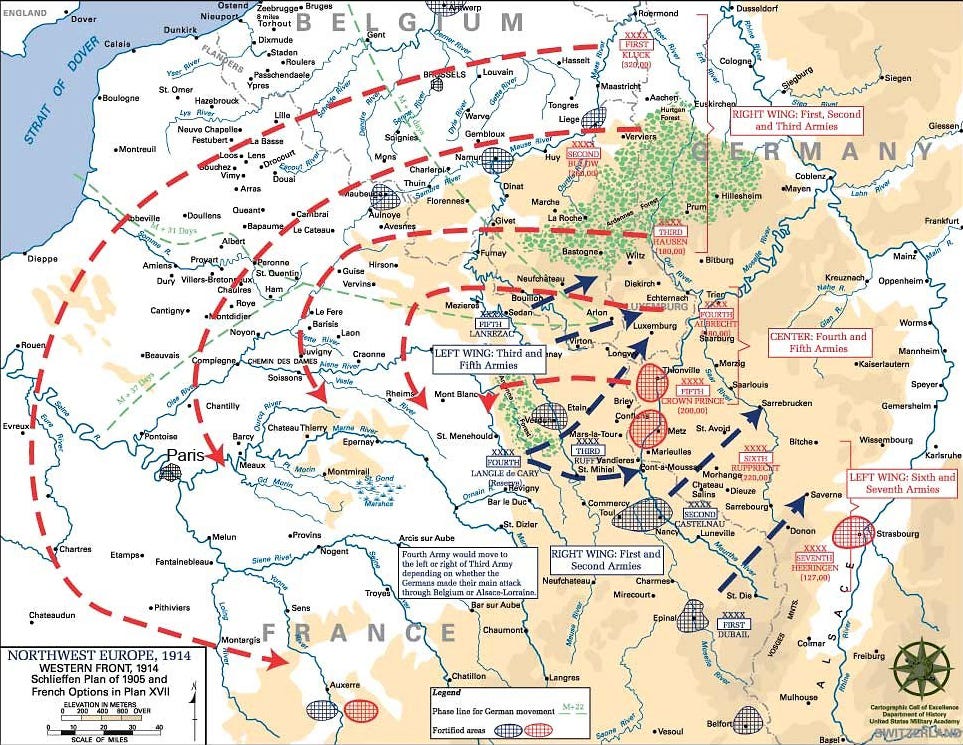
Schlieffen envisaged a stunning opening blow that would deliver complete victory over France in a six-week war. How would this be achieved? A small German and Austro-Hungarian force, nine per cent of the total, would temporarily hold the Russians on the eastern front (it was assumed they’d take weeks to mobilise), while the rest of the German Army would crash across the French border and destroy the French via a vast circling motion through Belgium. And then Germany would hurl her remaining military might on the eastern front and destroy the Slavic armies.
It was an ‘all or nothing’ gambit that critically depended on defeating France within the first few weeks of battle – that is, before the Russians were able to mobilise their enormous population.
Mobilisation - ‘launching’ their trains - by any one of the belligerent powers would force the others to enact panic-stricken mobilisation orders, with the result that huge, unstoppable forces would be set in motion (see ‘War by train timetable’).
To fight and win on two enormous fronts required of Germany an astonishing feat of arms, unprecedented in human history.
‘The total battle as well as its parts,’ Schlieffen wrote in 1909, ‘the separated as well as the contiguous battles, will be played out on fields and across areas that dwarf the theatres of earlier martial acts.’
Schlieffen compared this great act to Hannibal’s victorious campaign at Cannae:
‘A battle of annihilation can be carried out today according to the same plan devised by Hannibal in long forgotten times. The enemy front is not the goal of the principal attack. The mass of the troops and the reserves should not be concentrated against the enemy front; the essential is that the flanks be crushed. The wings should not be sought at the advanced points of the front but rather along the entire depth and extension of the enemy formation. The annihilation is completed through an attack against the enemy’s rear . . . To bring about a decisive and annihilating victory requires an attack against the front and against one or both flanks.’
—
Schlieffen’s plan gathered, like iron to a magnet, a solid following of senior German commanders. They saw in the grandeur of his vision the deliverance of Germany from the fear of encirclement. A kind of mystique attached to the plan, as if it were a sacred parchment retrieved from some ancient tomb.
Of course, the Schlieffen Plan did not determine or precipitate the war of 1914; men did. ‘The effect,’ observed Keegan, ‘exerted by paper plans on the unfolding of events must never be exaggerated. Plans do not determine outcomes.’
Even so, the most powerful men in Germany, such as the Kaiser and Helmuth von Moltke, chief of the Great German General Staff, were heavily influence by Schlieffen’s vision. German commanders tended to act in the thrall of his mind-boggling vision. His ideas offered a relief valve to the ‘siege mentality’ that possessed the senior members of the General Staff.
If cracks appeared in his masterwork, Schlieffen was confident that none had escaped his owl-like scrutiny.
In fact, they were not errors of detail but rather flaws in the very conception; a disease in the trunk rather than the leaves. But to admit that would be to admit failure, and failure was inconceivable to a man of Schlieffen’s temperament: stubborn and supremely self-assured, he recognised only ‘contingencies’ that must be met. Such as:
What would happen if the English fought on France’s side? Schlieffen answered that the Germans would ‘defeat the English and continue the operations against the French’.
Were enough troops available? Schlieffen recommended the raising of eight new army corps, to be deployed on the right wing.
How would so many troops be transportable to the front line? By train to the railhead on the border and then by road, thereafter marching 12 miles (19 kilometres) a day.
Would the Belgians simply stand aside and watch the German steamroller pass through? Schlieffen assumed they would.
Could the Russians be held while the Germans routed the French? Yes, Schlieffen insisted.
—
Critical to the success of the plan was the kind of war Schlieffen prescribed: a swift German triumph reminiscent of the stunning Prussian victory over France in 1871.
Schlieffen ruled out a long war of attrition, which Germany could not afford: ‘A strategy of attrition will not do if the maintenance of millions costs billions.’
To avoid that costly mistake, the troops would be pressed to complete the conquest of France within a few weeks, calculated down to the day: ‘It is therefore essential to accelerate the advance of the German right wing [via Belgium] as much as possible.’
The reason for the vast circling motion through Belgium lay on the border with Alsace and Lorraine, in the form of a line of huge French fortifications, from Verdun to Belfort, erected after the Franco-Prussian War.
German artillery lacked the firepower to destroy the French forts in the time required to penetrate the French interior, conquer Paris and regroup to attack the Russians in the east. Schlieffen’s answer was to avoid the forts altogether, by sweeping through Belgium, via the towns of Liège and Namur. He reached this conclusion as early as 1897, when he privately mused that Germany ‘must not shrink from violating the neutrality of Belgium and Luxembourg’.
—
So Belgium would act as the free corridor into the heart of France. Nobody believed little Belgium would dare oppose the German juggernaut; the very success of the Schlieffen plan turned on Belgium’s immediate surrender.
Under this scenario, virtually the entire German Army would violate Belgian neutrality (supposedly guaranteed by France, Britain and Prussia under the Treaty of London 1839), in the largest mass movement of troops ever sent to defeat a rival nation.
Belgium would serve as ‘a sort of funnel through which German armies could pass, then flood out beyond the French armies and encircle them’, writes the historian A. J. P. Taylor. It is worth reminding ourselves that this was the plan for a preventive war, a war of self-defence.
Schlieffen first openly named Belgium as the corridor for the invasion of France in his Great Memorandum of December 1905. This would apply (with revisions) up to 1914. It envisaged the bulk of the German Army – some 700,000 troops – wheeling across southern Belgium to reach the French border within 22 days.
Within ten days of that, the invaders would surround Paris from the west, and then drive eastward, to meet up with the German left wing. The remains of the French Army would then be crushed within this ‘great semi-circular pincer, 400 miles (645 kilometres) in circumference, the jaws separated by 200 miles (320 kilometres).’ Within 42 days, the war on the western front would be over, and Germany free to turn her forces on Russia.
Schlieffen’s plan, if properly resourced, would be the saviour of Germany, he believed.
Yet Schlieffen, his staff and their successors made a series of terrible blunders, as we shall see: they misjudged Belgium’s incredible resolve; underestimated the English; gravely misread Russia’s speed of mobilisation; and miscalculated the impediment of narrow roads to such a monstrous gathering of arms and men.
If the Schlieffen Plan ‘dreamed of a whirlwind’, wrote one critic, ‘the calculations warned of a dying thunderstorm’.
—
In retirement, in 1909, until his death in January 1913, Schlieffen continued to obsess over his great plan, entertaining new scenarios and fresh outcomes. The basic structure remained intact.
Schlieffen was prone in his dotage to view war in the abstract, as a vast operation on a map board, disembodied from the bloody clash of life and limb that his ink marks represented.
And he fretted deeply over the encirclement problem, keeping the theme alive in retirement, in his essay, ‘Der Krieg in der Gegenwart’ (‘The War in the Present’, January 1909).
Aged 80, Schlieffen wrote: ‘An endeavor is afoot to bring all these powers [France, Russia and Britain] together for a concentrated attack on the Central Powers [Germany, Austria- Hungary, Italy]. At the given moment, the drawbridges are to be let down, the doors are to be opened and the million-strong armies let loose, ravaging and destroying, across the Vosges, the Meuse, the Niemen, the Bug and even the Isonzo and the Tyrolean Alps. The danger seems gigantic.’
On 2 January 1912, the Kaiser read this lurid description of German encirclement to his generals and concluded, ‘Bravo.’
Moltke, Schlieffen’s successor, warmly praised it, and General Karl von Einem, the minister of war, saw no reason not to publish and disseminate it. In 1914, the German nation would enact it.
Next Thursday, 21 May 2026: Delusions of a love-sick Austrian boy
Selected sources and further reading:
Carroll, E. M., Germany and the Great Powers 1866–1914: A Study of Public Opinion and Foreign Policy, New York, Prentice Hall, 1938
Curtis, V.J., ‘Understanding Schlieffen’, The Army Doctrine and Training Bulletin, Vol 6, No. 3 (2003)
Geiss, Imanuel, July 1914 The Outbreak of the First World War: Selected Documents, Charles Scribner’s Sons, New York 1967
Herwig, Holger, ‘Imperial Germany’, in May, Ernest R., Knowing One’s Enemies: Intelligence Assessment Before the Two World Wars, Princeton University Press, New Jersey 1986
Keegan, John, The First World War, Vintage, London 2000
Moltke, Helmuth von, Essays, Speeches, and Memoirs of Field Marshal Count Helmuth von Moltke, Vol. 1 of 2 (Classic Reprint), Forgotten Books, Hong Kong 2012
Murray, W., Knox, A., and Bernstein, M., The Making of Strategy: Rulers, States and War, Cambridge University Press, Cambridge 1996
Ritter, Gerhard, The Schlieffen Plan: Critique of a Myth, Praeger, New York 1958
Strachan, Hew, The First World War, Penguin, London 2005
Strachan, Hew, The First World War: Volume I: To Arms, Oxford University Press, USA 2003
Taylor, A. J. P., War by Timetable: How the First World War Began, Endeavour Press, London 2013
[This essay is an edited extract from my book 1914: The Year the World Ended published by Penguin Random House]
The usual lucid and poetic writing Paul, thanks for sharing your gift, always fascinating to glimpse your mind in those you enter to explicate.
I invite you to join our The Philosophy of Responsible Freedom Session 23 THE LETHAL COMMUNICATIVE DISEASE OF LONELINESS
https://responsiblyfree924276.substack.com/p/the-philosophy-of-responsible-freedom